What a CAM reconciliation actually involves
A walk through the CAM reconciliation from expense pool to tenant statement, with a worked example and the three cap mechanics compared.
Ledgerstone · June 18, 2026 · Updated October 17, 2026 · 8 min read
Common area maintenance reconciliation is the annual exercise of comparing what tenants were billed in estimates against what the property actually spent, and issuing the difference as a bill or a credit. Described that way it sounds like subtraction. In practice almost all of the work happens before the subtraction, in deciding which numbers are allowed into it.
This is the long version: the sequence, a worked example you can check with a calculator, the three cap mechanics that produce three different answers from the same expenses, and the four places it reliably goes wrong.
The five steps, in order
Every reconciliation, regardless of property type, runs the same sequence.
- Assemble the expense pool. Take the period's actual operating expenses from the accounting system for the property in question.
- Apply exclusions. Remove what the leases say is not recoverable — commonly capital improvements, leasing commissions, and the owner's own legal and financing costs.
- Adjust the pool. Gross up variable expenses to a stated occupancy, if the leases provide for it, and split the pool into recovery groups where different tenants share different categories.
- Allocate to each lease. Apply each tenant's share, usually pro-rata by rentable area, though other methods appear.
- Apply the lease's own limits. Subtract the base year or expense stop, apply caps, then compare the result against what was billed in estimates.
The order matters. A cap applied before the base-year deduction produces a different number than a cap applied after, and the lease language decides which is correct. There is no industry default to fall back on.
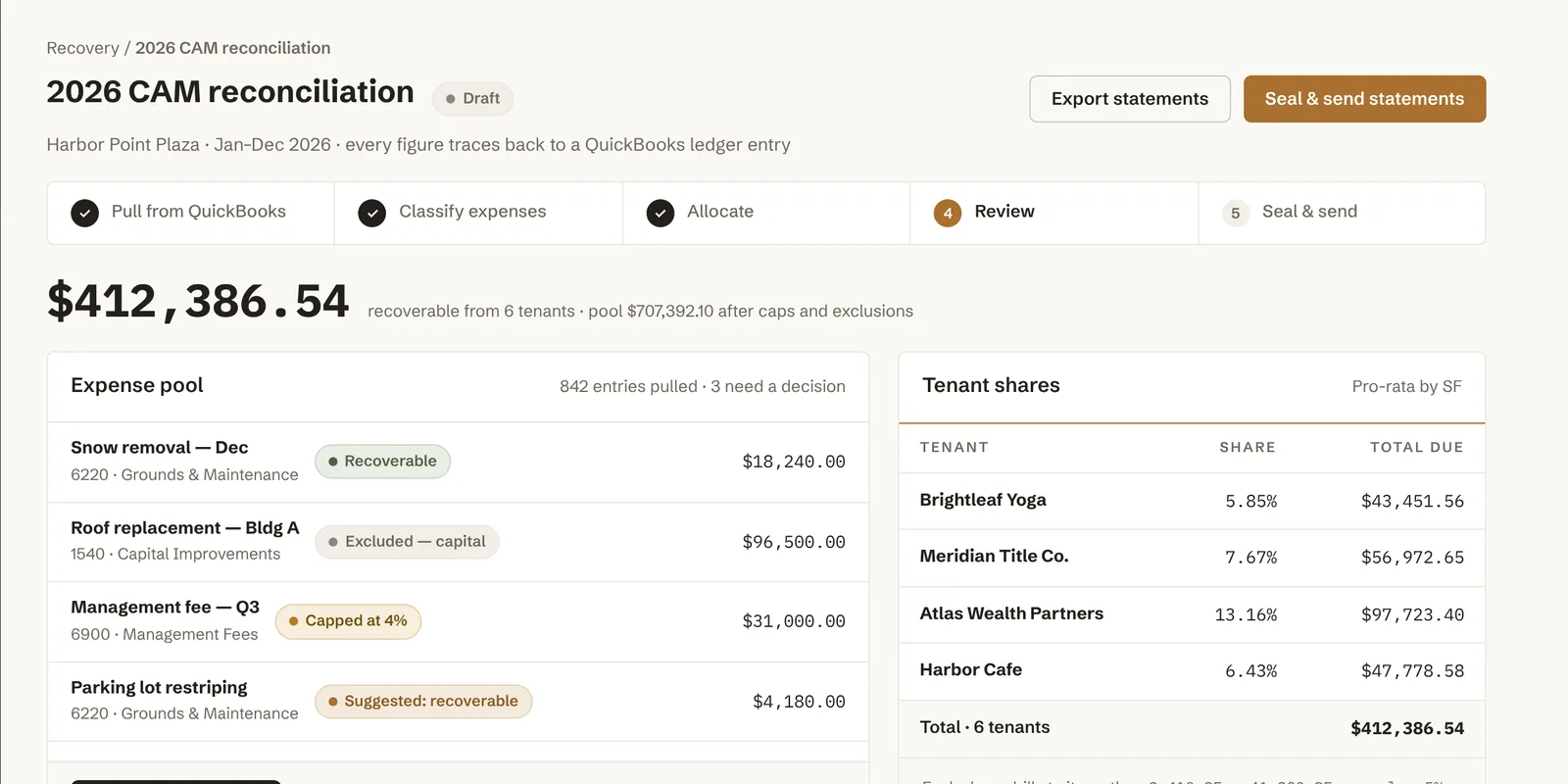
This is what the tenant actually receives. See a sample statement
A worked example
One property, one tenant, one year. Every figure below is arithmetic you can check.
The property. 100,000 rentable square feet, six tenants, 80% occupied through 2026.
The tenant. Suite 210, 8,000 rentable square feet, on a base-year lease with 2023 as the base year, paying $900 a month in CAM estimates.
Step 1 — the gross pool
Operating expenses posted to the property for the year: $1,240,000.
That is the number the books produce. It is not the number the tenants see.
Step 2 — exclusions
| Excluded item | Amount | Why |
|---|---|---|
| Roof replacement, Building A | $180,000 | Capital improvement, not maintenance |
| Leasing commissions | $44,000 | Cost of leasing space, not operating it |
| Legal fees, refinancing | $16,000 | The owner's cost of capital |
| Total excluded | $240,000 |
Pool after exclusions: $1,000,000.
The roof is the one that matters most and it is the one that is argued about most. A roof replacement is capital; a roof repair is usually operating. Where the lease draws that line — and whether it allows capital items to be amortized into the pool over their useful life — decides whether $180,000 enters the calculation or not. On an 8% tenant share, that single classification is worth $14,400 to this one tenant.
Step 3 — the gross-up
Gross-up exists so that a tenant in a half-empty building does not pay a larger share of a fixed cost than they would in a full one. It applies to expenses that move with occupancy, and not to expenses that do not.
| Amount | Grossed up to 95% | |
|---|---|---|
| Variable: janitorial, utilities, trash | $400,000 | $400,000 × (95 ÷ 80) = $475,000 |
| Fixed: insurance, landscaping, security, management | $600,000 | unchanged at $600,000 |
| Grossed-up pool | $1,075,000 |
Two things to notice. The gross-up increased the pool by $75,000 — it is not a discount to the tenant, it is a correction that makes a partly-occupied building bill like a full one. And it applied only to the variable half. Grossing up the full $1,000,000 would have produced $1,187,500, which is $112,500 of expense that nobody incurred.
Step 4 — the tenant's share
Suite 210 is 8,000 of 100,000 rentable square feet, so 8.00%.
$1,075,000 × 8.00% = $86,000
Step 5 — the base year, then the comparison
A base-year lease says the tenant pays only the growth in operating expenses above what they cost in the base year. Suite 210's base year is 2023, when its 8% share came to $74,000.
| Line | Amount |
|---|---|
| 2026 share of the grossed-up pool | $86,000 |
| Less 2023 base-year share | ($74,000) |
| Recoverable from this tenant | $12,000 |
| Less estimates billed, $900 × 12 | ($10,800) |
| True-up owed by the tenant | $1,200 |
That $1,200 is the only number the tenant sees on a bad statement. Everything above it is what they will ask about on a good one.
The trap in this step. The base year has to be computed the same way the current year is. If 2026 is grossed up to 95% and the 2023 base was never grossed up, the comparison is between two different things, and the tenant pays for the difference in methodology rather than the difference in cost. This is the single most expensive quiet error in base-year leases, because it compounds: the inflated gap persists for every remaining year of the term.
Caps: three mechanics, three answers
A "5% cap" is not one thing. Take one tenant on a capped lease, hold the actual costs and the stated 5% fixed, and the lease language alone moves the 2026 bill by nearly $4,000.
Base-year (2023) share of controllable expenses: $50,000. Actual share since: 2024 $54,000 · 2025 $58,500 · 2026 $64,000.
| Cap mechanic | 2024 ceiling | 2025 ceiling | 2026 ceiling | 2026 billed |
|---|---|---|---|---|
| 5% simple, measured from the base year | $52,500 | $55,000 | $57,500 | $57,500 |
| 5% compounded from the base year | $52,500 | $55,125 | $57,881 | $57,881 |
| 5% on the prior year's actual | $52,500 | $56,700 | $61,425 | $61,425 |
Same property, same costs, same "5%", and a $3,925 spread on one tenant in one year. Across six tenants and a four-year term, that is real money being decided by a clause nobody re-reads.
Three points worth keeping:
- Controllable versus uncontrollable. Most caps apply only to controllable expenses. Taxes, insurance and utilities are commonly carved out, which means the pool has to be split before the cap can be applied at all.
- Cumulative caps have memory. Where unused cap room carries forward, this year's ceiling depends on what was billed in every prior year — so a reconciliation depends on the reconciliations before it, and re-opening an old year changes the current one.
- Order of operations. Cap then base year, or base year then cap, are different numbers. The lease decides. If it does not say, that is a question for counsel before it is a question for a spreadsheet.
Where it usually goes wrong
Four failure points come up repeatedly, and none of them is arithmetic.
The pool is assembled by hand
If the recoverable expenses are picked out of the general ledger manually each year, the selection is a judgement call that has to be re-made — and re-defended — every time. Two people assembling the same pool from the same ledger can reasonably produce different pools. Worse, the same person can produce different pools in different years, and nothing in the output reveals that the basis moved.
The fix is not care. It is making the classification a property of the account rather than a decision taken annually under deadline.
The gross-up is applied to the wrong expenses
Grossing up a fixed expense inflates the pool, and it is one of the most common sources of a disputed statement. Insurance does not cost more because the building is full. Landscaping does not either. Cleaning does.
The test is a question about the expense, not about the category name on the invoice: if the building went from 80% to 95% occupied, would this cost have risen? If not, it is fixed, whatever the chart of accounts calls it.
Caps are treated as annual when they are cumulative
Covered above. The symptom is that the reconciliation is correct in isolation and wrong in sequence, which means it survives review and fails an audit.
The derivation is not kept
The reconciliation is done, the statement goes out, and the working is in a workbook that gets overwritten next year. When a tenant asks how a number was reached — and a sophisticated tenant will, often eighteen months later when the person who built it has left — the answer has to be reconstructed rather than retrieved.
Reconstruction is not just slow. It is a negotiation you enter without evidence.
Go deeper
Each of the four failure points above has a post of its own: what the gross-up clause actually does, the four cap mechanics compared, which operating expenses are recoverable, and what to do when a tenant disputes the statement. To run the arithmetic on your own figures rather than these, the CAM calculator does the whole sequence in the browser.
What a tenant will actually ask
A statement that survives scrutiny answers these before they are asked:
- What was in the pool, and what was taken out of it?
- Was anything grossed up, to what occupancy, and which expenses were treated as variable?
- What is my share, and what is the denominator — rentable area, occupied area, or something the lease defines?
- What did the cap do this year, and what is my cap room going forward?
- What did I already pay in estimates?
Five questions. A good reconciliation answers all five from its own records; a poor one answers them from somebody's memory.
What makes the next one easier
The reconciliation is not really an annual task; it is an annual output of decisions made once. The recovery groups, the exclusions, the gross-up policy, the cap mechanics and each lease's share are all stable between years. The only genuinely new input is the period's expenses.
When those decisions live in a system rather than in a workbook, the annual work reduces to pulling the period's expenses and reviewing the result — and the derivation is still there in eighteen months, when somebody asks.
That is the difference between doing the reconciliation again and running it again.
Related reading
- CAM reconciliation software — what to evaluate, and where a reconciliation spreadsheet stops working.
- Base year versus expense stop — the two structures that decide what the tenant pays above.
- What lease administration covers — where the terms driving all of this are supposed to live.
- Commercial lease escalations — the other scheduled number in the lease.
Terms in this post
CAM · CAM estimate · CAM reconciliation · Common area · Expense pool · NNN · Pro-rata share · True-up · Full glossary
Keep reading
See it run on your own leases. Book a demo